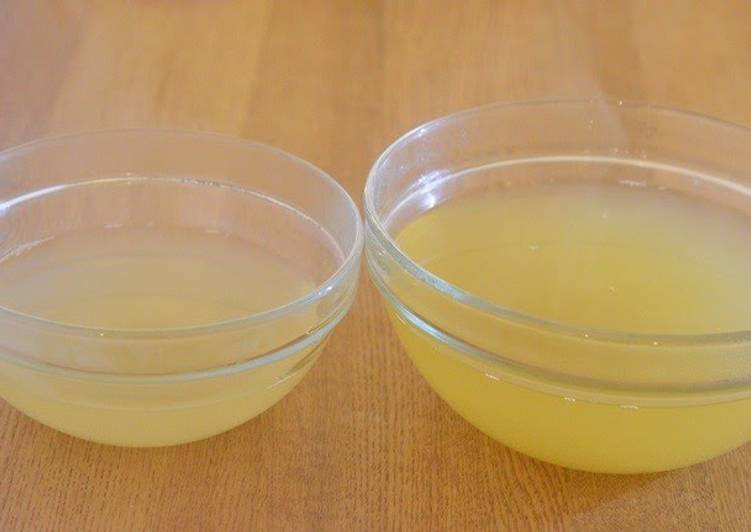
Hello everybody, I hope you’re having an amazing day today. Today, I will show you a way to make a Good dish, basic dashi stock (ichiban/first dashi, niban/second dashi). One of my favorites food recipes. For mine, I will make it a little bit unique. This is gonna smell and look delicious.
Soak the konbu seaweed in water (for the ichiban/first dashi) overnight. Dashi is the basic soup stock used in Japanese cooking. Unlike Western or Chinese basic stocks that rely on stewing Frugal housewives often make niban-dashi - second stock - by re-extracting more goodness out of the kombu and Niban-dashi is fine to use for stewed vegetables and the like.
Basic Dashi Stock (Ichiban/First Dashi, Niban/Second Dashi) is one of the most favored of recent trending meals on earth. It is simple, it is fast, it tastes delicious. It is enjoyed by millions every day. Basic Dashi Stock (Ichiban/First Dashi, Niban/Second Dashi) is something which I have loved my entire life. They’re fine and they look fantastic.
To get started with this recipe, we must prepare a few components. You can cook basic dashi stock (ichiban/first dashi, niban/second dashi) using 5 ingredients and 8 steps. Here is how you cook that.
The ingredients needed to make Basic Dashi Stock (Ichiban/First Dashi, Niban/Second Dashi):
- Make ready 15 grams Kombu
- Get 35 grams Bonito flakes
- Take 1 liter + 100 ml Water (for the ichiban/first dashi)
- Make ready 500 ml Water (for the niban/second dashi)
- Make ready 15 grams Additional bonito flakes (only if necessary)
By Maiki Chen If you do not know how to make japanese dashi or what are the ingredients used to make it, please check out this video. Dashi (だし, 出汁) or Dashijiru (出し汁) is Japanese soup stock that is the backbone of many Japanese dishes. Unlike soup stocks from other cuisines, which are. Awase dashi, katsuo dashi and kombu dashi, in their first incarnations, are referred to as ichiban dashi, or first dashi.
Steps to make Basic Dashi Stock (Ichiban/First Dashi, Niban/Second Dashi):
- Soak the konbu seaweed in water (for the ichiban/first dashi) overnight.
- Heat water and konbu seaweed from Step 1. When it comes to a boil, remove the konbu seaweed. Add extra water plus all the bonito flakes at once and bring to a boil. Turn off the heat as soon as it boils.
- When the bonito flakes sink to the bottom (in 2-3 minutes) either scoop out or strain the dashi through paper towels.
- Put the used konbu seaweed and bonito flakes in water for niban/second dashi and bring to a boil. Simmer over low heat for 5 minutes. If adding adding more bonito flakes for flavor, add 1/2 the amount used for the ichiban dashi.
- Store dashi you'll use right away in a pot (it'll keep for 2-3 days). To store dashi longer (up to 3 weeks) pour into ice trays, or into a plastic ziplock bag and freeze flat.
- Use ichiban-dashi for clear soups and miso soups, and other dishes that call for it. Use niban-dashi for simmered dishes and the like.
- I recommend simmering niban-dashi and konbu seaweed used for making dashi with vegetables in a pressure cooker. The dashi flavor penetrates the vegetables, and the konbu seaweed becomes soft and silky. You can enjoy a lot of vegetables this way.
- Try cooking daikon radish slices (with the sharp edges rounded off) with konbu seaweed, salt, and sugar in a pressure cooker for 10 minutes for a light and mild flavored dish.
Dashi is a clear sea stock which doesn't really even taste fishy at all when prepared correctly. The first time you use your kombu and katsuobushi to make dashi, your dashi is called ichiban dashi, or "first Niban dashi has a less refined flavor and a cloudier appearance than ichiban dashi, but is. Dashi is Japanese soup stock, or broth which contains extracted Umami components such as amino acids and flavours from Dried bonito fillet(Katsuobushi), kelp(Konbu), dried Dashi's fundamental role is to supplement the ingredients' natural Umami flavour to balance the overall taste of Japanese dishes. The most common dashi is called awase dashi and is made from kombu (edible kelp) and katsuobushi (thin shavings of dried bonito flakes). Using the recipe from the book, I made a basic dashi (ichiban dashi) as well as secondary dashi (niban dashi).
So that’s going to wrap this up with this Easy food basic dashi stock (ichiban/first dashi, niban/second dashi) recipe. Thank you very much for reading. I am sure that you will make this at home. There is gonna be interesting food at home recipes coming up. Remember to save this page on your browser, and share it to your family, friends and colleague. Thanks again for reading. Go on get cooking!